
Why Can’t Tariffs Help the American Middle Class?
Four facts and a conclusion.

Richard Baldwin, Professor of International Economics
Factful Friday 13 February 2026, reposted from 11 April 2025.
Introduction
OMG. Did you see that? Of course you did.
Remember where you were—because you’ll be telling your grandkids about this belated April Fool’s joke that got tragically real. The past seven days will go down in history as the grandest folly of economically illiterate populism since… well, it’s hard to say. No, it wasn’t the Cultural Revolution. And no, it wasn’t the Holodomor. But it has done, and will continue to do, immeasurable economic damage to America and many of its trading partners.
Let’s just say this economic wonder drug should have gone through animal trials—before being applied to the global economy. And it’s not over.
This episode of “The Trump Tariff Show, Season 2” has drawn to a close, but the US administration has already clicked on “Next Episode.” And if the trailer is anything to go by—it’s going to be a doozy. Check out Evenett and Fritz (2025) for a recap if you are fuzzy on the plot twists in this episode.
This Factful Friday argues that the tariffs will not, indeed cannot, redress the woes of the American middle class. I’ve harvested some bit of this post from earlier ones, but that’s okay because many of you weren’t paying attention to tariffs until back then. That was when tariffs were boring, not bombing.
The tariff medicine will not, indeed, cannot help the middle class.
Don’t believe the hype: raising tariffs to “level the playing field” will not help the middle class—quite the opposite. My argument rests on four facts and a conclusion.
Fact 1: Services can’t be tariffed.
This fundamental yet often overlooked economic reality is the key. Now when I say “can’t be tariffed,” I mean like no one in the world has figured out how to do. Lots of Emerging Economy governments are trying to figure out how to tax service exports from Advanced Economies, but they failed.
Tariffs are taxes on imports that are imposed when the goods pass through customs. Since services do not pass through customs, they cannot be tariffed. Some nations tax service imports with things like Value Added Taxes (VAT), or corporate taxes, but that is not what President Trump is talking about. Just think about the international trade in services that is going on in the LinkedIn world. How much of that is even recorded? And how would you know which types of services are being imported, and from where? If you don’t measure it, you can’t tariff it. That’s the core reason services can’t be tariffed.
Fact 2: Tariffs only help workers in goods-producing sectors.
Here’s the textbook economics: tariffs on imported goods protect domestic firms that compete with imports by raising the relative cost of their foreign rivals. When things work as they do in the textbook diagrams, the tariff raises both sales and prices of domestic firms. This is how they can protect domestic firms and their workers in goods-producing sectors.
There are lots of aspects of reality that are excluded from the textbook analysis, and many of these limit, or even reverse, the protecting effects of tariffs, but leave that aside. Let’s just suppose that tariffs help American workers in manufacturing and agriculture.
Fact 3: Few middle-class workers have jobs in goods-producing sectors.
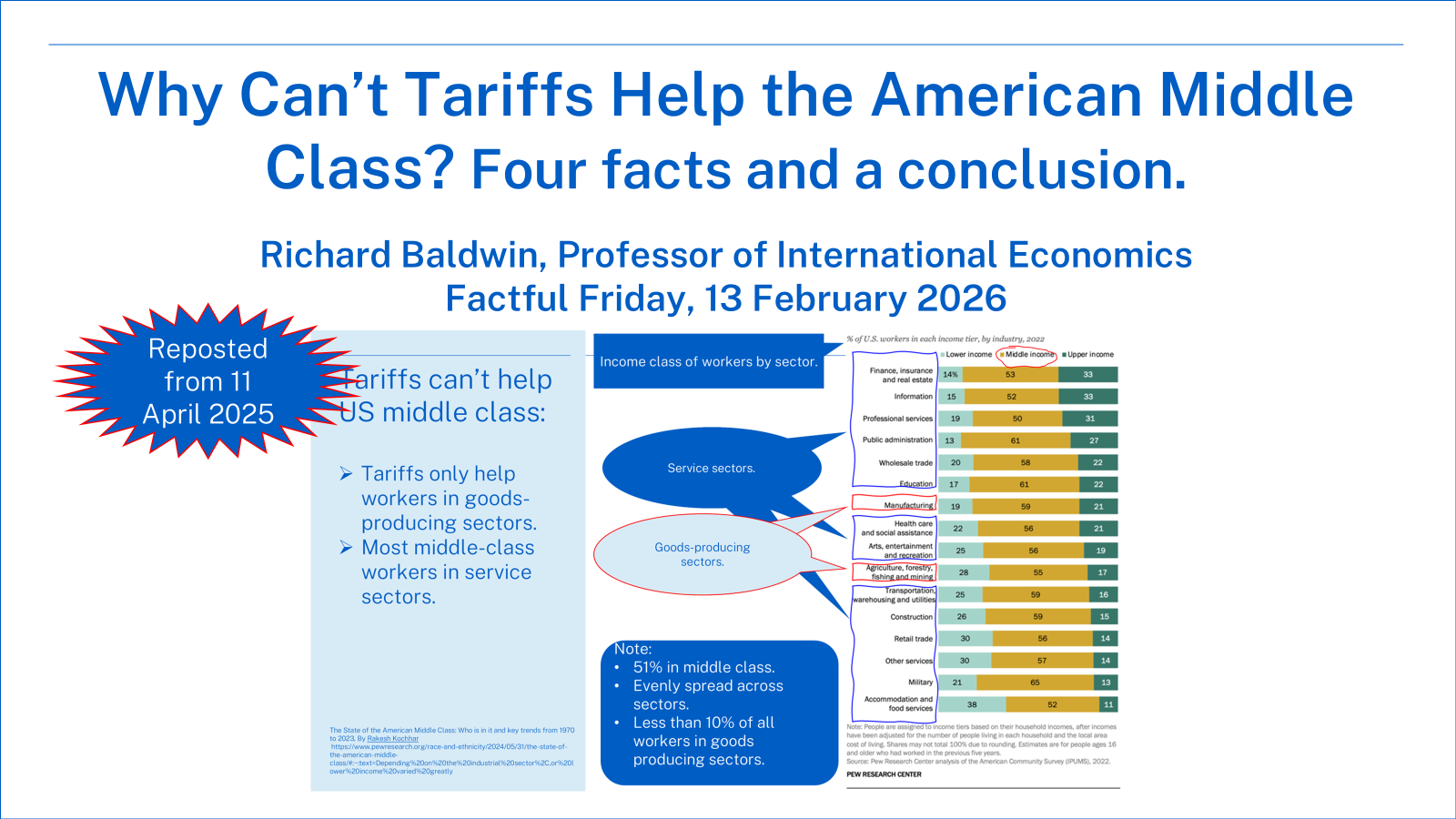
This is the second critical fact that is both widely known and widely ignored in the tariff debate is that few Americans work in goods-producing sectors. Manufacturing, for example, employs only about 8% of the US labor force, with another 2% or so working in agriculture, mining, forestry, and fishing. Okay, that 10% in goods-producing sectors, but 10% is an unimpressive share.
What do the other 90% do? They’re engaged in the service sector—teachers, nurses, restaurant staff, retail workers, office workers, software developers, and more. Check out the chart below.
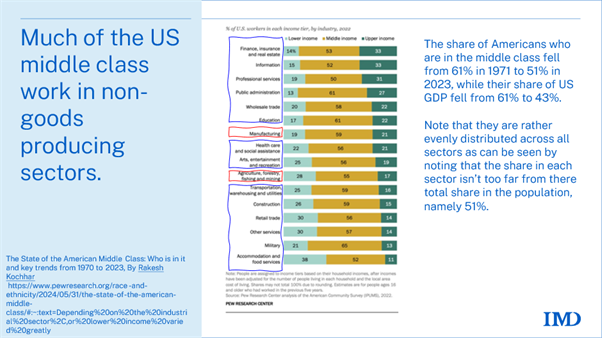
As noted, tariffs do nothing to protect or boost these jobs. A 125% tariff on Chinese goods will do basically nothing to shield American service workers. Just the opposite. Since tariffs protect by raising the US prices of goods, tariffs on Chinese imports raise the cost-of-living for service-sector workers.
The 90% of middle-class workers will pay more for the goods they buy daily. Think groceries, clothes, shoes, electronics, cars, and pharmaceuticals—all everyday items which will now be tariffed.
Thus, tariffs actively erode the purchasing power of most middle-class households, hitting hardest the people who were already struggling financially. Ironically, the very solution touted to relieve economic anxiety ends up exacerbating it for the vast majority of middle-class workers.
Fact 4: Social policies that would help—like Canada’s—require higher taxes and bigger government, which is politically impossible in the US.
The distress of the American middle class isn’t primarily due to trade or globalization alone. Rather, it is the result of structural economic shocks—a combination of rapid globalisation (especially industrial offshoring) and robotics, which I call the “globotics shocks” in Baldwin (2019).
These shocks forced a disruptive economic transformation in all advanced economies during —the 1990s, 2000s, and 2010s. The middle class working in goods-producing sectors found themselves competing with robots at home and China abroad. And not just in America. The globotics shock hit every advanced economy in the world. Remember we used to call the Advanced Economies by another name: the “industrialised nations.” Now all of them are de-industrialised. All of them have shifted to a post-industrial society where most of the goods jobs are in advanced services and require advanced degrees.
While the Globotics Shock was common, the middle-class malaise was not. Other advanced economies, such as Canada and much of Europe, mitigated these shocks through robust social safety nets and active government policies designed specifically to support displaced and economically vulnerable workers. The difference in outcomes is astounding.
The combination of the globotics shock and social policy based on trickle-down economics produced outcomes in the US had never seen since the 1930s (if ever). Today, US newsfeeds are filled with school shootings, middle-class drug addiction, an obesity epidemic, medical bankruptcies, high maternal mortality rates, crushing student debt, world-leading incarceration rates, high rates of old-age poverty, concerning levels of homelessness, low levels of marriage, rising suicide rates among the middle class, and other deaths of despair. While things are tough for many workers in other advanced economies, such social pathologies are unknown at comparable levels.
These slow-burn hardships confronting the American middle-class are not the middle-class’ fault. It’s a result, in my view, of the shocks hitting a society that had only the thinnest of social policy to smooth over the globotics upheaval. It was the shocks without a safety net, not the shocks alone.
Unlike Canada or European workers, middle-class Americans faced the economic displacement alone. The US lacked, and still lacks, the support taken for granted by workers in all other advanced economies. I’m talking about policies like universal health care, paid parental leave, paid vacation days for all, largely free university education, organised (and paid) apprenticeships, social housing, strong public pension systems that prevent old-age poverty, long-term unemployment benefits, and many active labour market policies that help people get new work when they are displaced by exogenous shocks of any type. The idea is to protect all workers, not just those with particular jobs.
Things are far from perfect in these so-called social market economies. They too have middle-class discontent—but not on the US scale. This is one reason that in most other advanced economies, the backlash is not really about trade, it’s about immigration.
For reasons that are hard for me to understand, the median American voter seems to react in horror to the idea of providing the social policies that workers in other advanced economies take for granted. The notion that bigger government providing the sort of “helping hand” policies from FDR’s New Deal and raising taxes on high-income earners and corporation to pay for it, is a no-go zone in the American political landscape.
In the absence of politically feasible solutions to address the real root causes of middle-class malaise, U.S. politicians across the spectrum—Democrats and Republicans alike—have resorted to shifting the blame overseas, scapegoating foreign trade and globalization, with China as the prime target.
Conclusion: Tariffs won’t solve U.S. middle-class malaise.
So why are tariffs so popular among so many traditional Democrats and Republicans like (recall that the US trade hesitancy started in the first Obama Administration in 2009).
Democrats and Republicans use tariffs, and a general anti-imports stance, as an excuse for not doing things that would actually help. Tariffs are political expediency—a tactic to divert attention from deeper domestic issues and uncomfortable policy realities. As tariffs prove economically ineffective for the majority of American workers and politically unfeasible solutions remain off the table, America will stay trade-hesitant, or trade-hostile for years.
Summary and concluding remarks.
The populist trade backlash isn’t popular because it solves economic problems—it’s popular because it conveniently assigns blame for them. Politicians, wary of confronting domestic issues that demand politically uncomfortable solutions like higher taxes and larger governments, embrace tariffs precisely because they offer an easy scapegoat. They point fingers abroad rather than looking inward.
But the deeper truth—the uncomfortable conclusion we must face—is that this tactic resolves nothing. Tariffs do not address the underlying economic insecurities of America’s middle class. They exacerbate problems by inflating costs for consumers and stoking geopolitical tensions that harm everyone in the long run.
Unless U.S. political culture evolves substantially—something that currently seems unlikely—the persistent hostility toward global trade, combined with the ongoing neglect of necessary social policies, ensures both middle-class economic anxiety and America’s anti-trade sentiment will remain defining characteristics of U.S. politics for the foreseeable future.
Understanding these realities clearly is the first step toward productive dialogue. Only then might we begin to search earnestly for meaningful and feasible solutions that can genuinely support and sustain America’s middle class—solutions that move beyond scapegoating to the tougher, necessary conversations about domestic priorities and policies.
References.
Baldwin, Richard (2019). The Globotics Upheaval: Globalization, Robotics, and the Future of Work, Oxford University Press.
Evenett, S., & Fritz, J. (2025, February 14). US reciprocal tariffs: Upending the global trade policy landscape. VoxEU.org. https://cepr.org/voxeu/columns/us-reciprocal-tariffs-upending-global-trade-policy-landscap
e
Services are mainly non-traded, and thus fall outside the remit of tariffs. Those that are traded are mainly services that a country would like to import (film, music, high- end finance, consulting, architecture, law, …), and that the US exports en masse.
services are protected through regulation in other countries and this restricts American exports and slows foreign growth, the imperative is to remove those trade barriers. the middle class malaise better described as industrial obsolescence thrusting the majority of workers into the precariat of simple services needs neither higher taxes nor larger government to remedy, in fact that prescription flows from the mentality of the problem which is the keynesian large state from 1950. the advanced countries face the transition from industrialization to automation and to make it and resolve obsolescence, increased state capacity is needed to develop infrastructure and commercial policy that unburden capital, lower the cost of externalities that prohibit automation outside the software realms, so that capital can iteratively test and discover latent comparative advantage in non software domains, and apply software where it will bring global advantage. as china shows, advance comes not from the keynesian state getting larger and supplanting capital, it comes from state capacity equipping capital to allocate. get smarter not fatter. a balance is needed between finance and development of software related domains and in an environment of lower cost/friction externalities, continuously probing latent advantage and making automate/exit decisions. the latter is the transition from industrialization to automation. there is the moral side too, cultivating higher education practitioners able to direct software, which relies on families and restored schools socializing children with stable emotion and temperament to learn more. the demand and supply of modern labor.