
Why Didn’t Trumpian Tariffs Wreck the World Trade System?
Because World War Trade didn’t spread.

Factful Friday by Richard Baldwin, Professor at IMD Business School. 27 March 2026.
In 2025, the US launched the most aggressive tariff assault the world has ever seen. It wasn’t the naïve protectionism of Smoot-Hawley. It was purposeful. It was intended to punish all US trade partners. It was retribution.
President Trump explained the tariffs by claiming that America “has been looted, pillaged, raped and plundered by nations near and far, both friend and foe alike.”
But something odd happened. History took a surprising turnoff as World War Trade escalated in 2025. Foreigners didn’t retaliate forcefully – except China and we’ll come to that story in a moment. Many economies got set to retaliate but then didn’t or did but withdrew them.
That is a puzzle.
Why didn’t Trumpian tariffs set off rounds of retaliation and counterretaliation?
The key to solving the puzzle is understanding that Trumpian tariffs weren’t about trade policy; they were about “tariff theatre”. That understanding has two implications that together explain the puzzle, but first let me try to convince you of the theatre-not-policy point.
If you think of Trumpian trade policy as economic policy, it will look chaotic, irrational and self-defeating. The policy looks erratic because it is not organised around standard economic goals such as efficiency, competitiveness or even a coherent mercantilism. It is organised around what I called the “Grievance Doctrine” in my 2025 book, The Great Trade Hack.[1]
To understand Trumpian tariffs, you have to change perspective.
Stop asking what the tariffs are meant to achieve economically. Start asking how they sound to the angry American middle class who are feeling victimised and humiliated.
Reread President Trump’s words about “looted, pillaged” and so on, and take them literally. Take them as reflecting his true mindset. Take those words as defining the “Grievance Doctrine”. President Trump is using tariffs to show that America is finally standing up for the forgotten men and women.
In short, Trumpian tariffs are all about generating ‘happy headlines’ that fulfil his campaign promise to restore American pride, stand up to global elites, and put America first.
Why did this reduce foreign tariff retaliation?
The first way is the simplest. The President chickened out on his boldest tariffs, so the economic impact on foreigners was nowhere near as big as the headline tariffs would suggest.
It was Saturday 1 February 2025 that President Trump launched his tariffs. On Monday, they were paused for 30 days. A month later, they were back. Days after that, they were softened again.
What was announced as shock and awe quickly became stop and go. What explained these policy pirouettes?
The pattern was simple: big, scary headline tariffs, followed, stealthily, by exemptions once the phone calls started. When Detroit pointed out that taxing Canadian and Mexican auto parts would hammer US factories, the President TACO’d. In my forthcoming book, World War Trade, I call this the ‘Rust Belt TACO’.
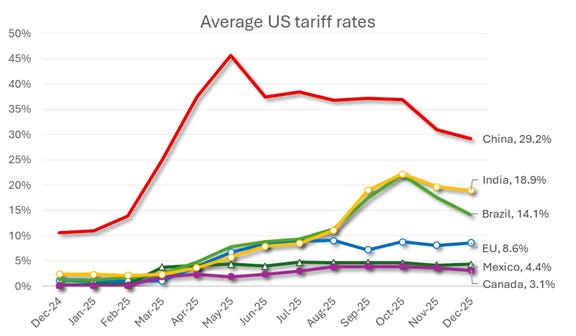
You can see this in the chart below. The average tariff on Mexican and Canadian exports to the US rose from close to zero to two or three percent. That is bad, of course, but the big Mexico and Canadian manufacturers, the ones that would traditionally push their governments to strike back, did not in fact get hurt much.
Source: Fitch Ratings. (2025, April 23). U.S. effective tariff rate monitor. Fitch Ratings. https://www.fitchratings.com/research/corporate-finance/us-effective-tariff-rate-monitor-23-04-2025
The second way is only slightly more complicated. Funny enough, retaliation didn’t work with Donald Trump because his tariffs were about theatre, not economics.
Traditionally, retaliation operates by punishing Washington via harm to US exporters. In Trump’s trade war, however, the administration appeared more responsive to domestic pressures created by the self-inflicted damage of its own tariffs than to exporter losses abroad.
For example, Canada retaliated but Mexico did not. The outcome, initially, was the same. They both got the same huge loophole via USMCA exemptions. For a reason that looks strange in a classic trade war. The US stepped back, but not due to the Canadian pressure. It was Detroit that demanded relief.
Moreover, since the tariffs were based on a grievance-laced narrative of victimhood, retaliation stoked the grievance. And this could, and in the case of China, did lead to even higher tariffs.
President Trump is making trade policy for optics, not outcomes.
This episode revealed that on tariffs, the Trump administration was shooting from the hip: firing off tariffs and recalling any bullets that hit its political base. This was most definitely not conventional US trade policy. It was fire, flinch, retreat, while spinning it all in the media as a victory. The most unexpected part was how the administration managed to portray both the imposition of tariffs and their suspension as victories.
The 1 February tariffs were heralded as bold action. It was proof that the President was standing up for the forgotten men and women of America. The White House wrapped the 3 February suspension in the language of strength: the President had forced concessions from foreigners on fentanyl-smuggling enforcement.
Obfuscation played a central role. The President had announced 25% tariffs on all goods from Mexico and Canada. These bold tariff rates generated headlines, but exemptions were granted that greatly reduced their economic impact. Goods that counted as made in North America (according to USMCA rules) were excluded from the 25%. This removed the tariffs on roughly 85% of imports from both countries.[2] Apart from articles in the business press, the public discourse focused only on the attention-grabbing 25% number.
In short, the Trump administration had found a new way to do American trade policy. The exemptions avoided most of the economic pain, while the headlines provided most of the political gain.
Foreign restraint saved the system.
There is another reason that tariff aggression didn’t spread. Washington triggered the trade war based on a grievance-laced narrative of victimhood built on the economically false claim that trade deficits are theft. Other nations did not share this view.
Most nations, including China, viewed the trading system as the goose that laid the golden eggs. It delivered prosperity, stability and predictability. A joint statement from Brazilian President Luiz Inácio Lula da Silva and Indian Prime Minister Narendra Modi in February 2026, for example, supported an “open, fair, transparent, inclusive and non-discriminatory multilateral trading system, with the WTO at its core”. Leaders from Beijing to Brussels echoed this.
Responses in capitals across the planet differed in detail but converged in substance. The American architect had turned arsonist, but no one else threw firebombs. The US had abandoned rules-based trade and embraced power-based coercion, but the rest chose law over leverage. Trade law over jungle law.
There is a very different explanation for why tariffs between the two largest economies are so low.
The China TACO defused much of the Trumpian tariff damage.
In April 2025, Donald Trump was confident that his tariffs gave him the upper hand against China.
The arithmetic seemed obvious. China exported far more to the US than the US exported to China. With tariffs at embargo-like levels, Chinese factories would feel the pain first. Beijing would blink. That was the theory.
But theory is different in practice than it is in theory.
The impact of the embargo-like tariffs wasn’t apparent in April 2025. But reality was on its way across the Pacific. The container ship voyage takes a few weeks, so ships at sea kept arriving from China, until they didn’t.
America’s 125% tariffs acted like an embargo. As Guardian columnist George Magnus put it: The sky-high tariffs mean “they have declared a trade embargo on each other, normally an act of war.” But in this case, the US had imposed the embargo on itself. The tariff battle with China was hurting US exporters to some extent, but real damage came from the impact of US tariffs on American manufacturing. This was self-harm.
The real disruption started in early May. The Port of Los Angeles, America’s main gateway for Chinese imports, faced a sharp drop in inbound volume. Truck traffic collapsed to holiday levels. Warehouses fell silent. Longshoremen were sent home. In April, Trump thought he was squeezing Chinese factories, and he was. In May, he discovered he was also squeezing American factories.
CEOs of the biggest American retailers, Walmart, Target, and Home Depot, warned Trump that his tariffs could trigger massive product shortages and price spikes. “Starting in a couple of weeks, we are just going to start running out of stuff, and if the administration waits to resolve the problem until we have shortages and hoarding, that is just too late,” said Sean Stein, president of the U.S.-China Business Council.
These impacts would hurt his political base, exactly the same people he had claimed to be standing up for. Trump needed to get his tariffs down to protect the forgotten Americans his tariffs were standing up for.
This was a milestone in the administration’s learning journey. Trade wars, it turned out, were not “good” when they emptied shelves and shut down your own factories. They were not “easy” when your supply chains rely on imports from your opponent. But by May, Washington’s act collided with US industrial reality, and reality won. The “good and easy” slogan had collided with 21st-century supply chain realities.
At this point, the politics and optics took control of the conflict.
The President had the legal authority to lower his tariffs instantly, but optics blocked that off ramp. His image is built on the projection of strength. Backing down would look like capitulation to China, and that would be way off brand. The President needed to recast history in a way that made the tariff withdrawal look a win.
It was a strange but instructive thing to watch this unfold in the spring of 2025. His first attempt was to claim that China was the one who was desperate to lower US tariffs, and that China suing for peace.
Trump claimed Xi had called; Beijing denied it.
Bessant asserted the Chinese were pushing to get a deal; Beijing denied it.
The two had reached a “you-ask-first” starring contest. Trump blinked first. On 9 May, Trump used social media to say the US would cut tariffs on China to around 80%. Trump’s 80% announcement was highly unusual for a trade war. Typically, tariff reductions come at the end of the talks. This time they came as the entrance ticket.
And the ticket Trump bought worked.
The unilateral offer gave President Xi the face-save he needed. Talks began in Geneva just days later.
After just two days of negotiation, the two sides agreed to shift from 125% to 10%. From the Rose Garden baseline of 34% and 0%, the US tariffs were down to 10% while Chinese tariffs were up to 10%. The US partner with the largest trade surplus now had the lowest tariffs.
The Wall Street Journal wrote, “Beijing called Mr. Trump’s bluff with hefty retaliatory tariffs,” causing the President “to sue for trade peace without any behaviour change from China.” Washington hadn’t known it was bluffing but China called its bluff, anyway.
Headlines of “US caves to China” would not have been a good look. What could the Administration do to avoid such headlines?
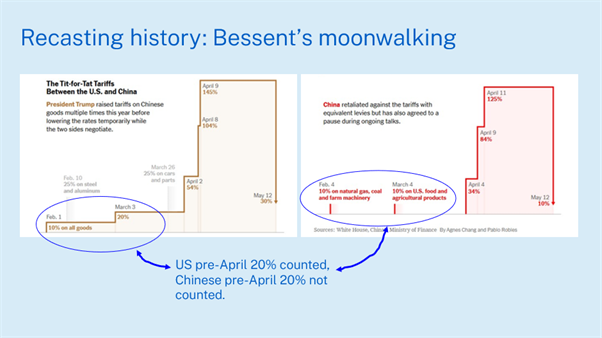
Secretary of Treasury, Scott Bessant did in May what he had done on 9 April when the US retreated from all the other Rose Garden tariffs. He matched the retreat with a recast of history to make a withdrawal look like a win.
The Secretary told the press that the US had kept 30% while China only got 10%, thus demonstrating that America still had the upper hand. Yes, it had been a tough match, but US won on points.
Much of the media dutifully transcribed Bessant’s backcasting of history, creating a widely held impression.
The New York Times, which fell for the spin, inadvertently illustrated the sleight of hand. In a timeline graphic tracing the tariffs’ ups and downs from February to May, The Times showed that both sides imposed 20% before the Rose Garden announcement. In the panel tracking US tariffs, the pre-April 20% was added to the April 125%, making it 145%. The panel tracking Chinese tariffs did not, making it 125%. Going into Geneva, the Times claimed, it was 145% vs 125%. Not 125% vs 125%. It’s all clear in the Times’ chart reproduced below.
But beneath the spin, something fundamental about World War Trade had been decided. The full-power test had produced its first lesson. China could withstand tariff pain longer than the United States.
China establishes escalation dominance; President Trump moves on.
By year-end, the US-China conflict was a long way from what it had been on that rainy April day in the Rose Garden.
China had demonstrated that it had the upper hand in tariff battles. US tariffs imposed an intolerable burden on American manufacturing given its reliance on Chinese inputs. Chinese exporters found other customers. After May 2025, US tariff rates on China moved only one way: downward, as the first chart in this Factful Friday shows.
China’s export controls, by contrast, remained in place. Beijing continued to apply its export controls in measured doses. American manufacturers were still complaining in 2026. Instead of retaliating, the US began relaxing some of the Biden-era export restrictions on China. This was the China TACO.
Strategists call this escalation dominance: the ability of one side to raise pressure further, absorb pain longer, and force the other side to back down. And China had it on both tariffs and export controls. In plain English, America’s reliance on Chinese industrial inputs gave China a stranglehold on US trade policy.
President Trump had neither won nor lost his trade war with China. In a now familiar retreat-and-recast move, he changed the subject and moved on.
The four TACOs that contained US tariff aggression.
The second puzzle is: Why did the US lower its 2 April 2025 tariffs so much?
As you will have noticed, I believe that those shocking Rose Garden tariffs launched on that cold, overcast day in April, were not meant to reshape the global economy. They were meant as a show of support for America’s rust-belt workers.
But Trumpian tariffs ran into reality and reality won. I’m old enough to remember the Spielberg movie called: Close Encounters of the Third Kind. It’s the tale about aliens and an intense, destructive, personal obsession. The lead, played by Richard Dreyfuss, is so obsessed with an image that he sacrifices everything he cares about. His only way out is leaving with the aliens.
Now I’m not sure why that came to mind, but tariffs have certainly been an obsession of the President’s for decade. His only escape from their negative political blowback inside the US has been to hollow out their impact with exemptions. In short, the tariff assault was not defeated abroad. It was contained at home.
US tariff aggression was contained by a series of domestic forces that led the President to do a series of TACOs. In my forthcoming book (did I mention I’ve got a book coming out?), I tell it as a tale of four TACOs.
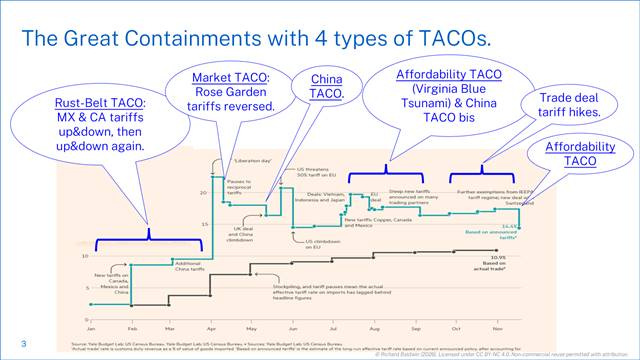
To give them names, the first was the Rust Belt TACO, when Donald Trump exempted imports from Canada and Mexico that were necessary to keep legacy US factories running, especially the auto industry. Financial market turmoil forced a huge climbdown on 9 April 2025. Call that the Market TACO. The US-China confrontation led to another sizeable reduction in US tariffs. Call that the China TACO. The most powerful and long-lasting TACO is the Affordability TACO. As it turns out, tariffs harmed the very voters President Trump wanted to stand up for.
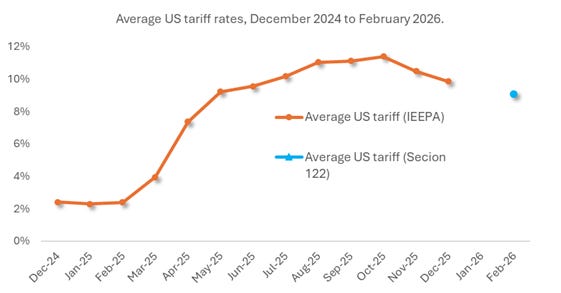
In the face of all these TACOs, the chart below shows that the average US tariff has been falling since October 2025, well before the Supreme Court pulled the plug on the President’s emergency tariff-setting powers.
Source: Fitch Ratings: US Effective Tariff Rate Monitor, accessed March 2026.
This was the Great Containment.
And that’s it for another Factful Friday.
BTW, I’ll catch up the Fridays I missed in the next few days, all as a drumroll to the release of my eBook (to be freely downloadable from CEPR.org).
[1] Baldwin, R. (2025). The Great Trade Hack: How Trump’s trade war fails and the world moves on. CEPR Press.
[2] Initially, only about 50% of imports from Canada and Mexico were imported under the USMCA tariff category and thus exempt, but by July 2025 the fraction was over 85% as importers started filling out the forms necessary to quality their goods for the exemption. See Penn Wharton Budget Model, https://budgetmodel.wharton.upenn.edu/legacy/excel/Effective_Tariff_Rates_and_Revenues_Data.xlsx